Thursday, March 2, 2017

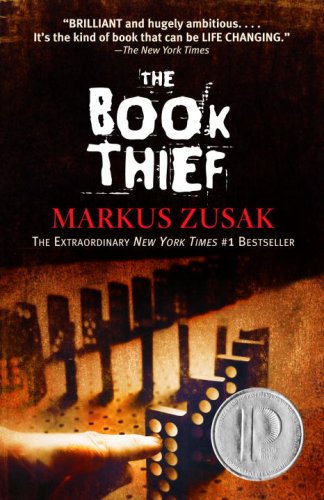
The Book Thief by Markus Zusak

It's National Book Day, so why not talk about a book that celebrates books, with one of my all-time favourite books ever, The Book Thief by Markus Zusak.

From Goodreads:
It’s just a small story really, about among other things: a girl, some words, an accordionist, some fanatical Germans, a Jewish fist-fighter, and quite a lot of thievery. . . .

Set during World War II in Germany, Markus Zusak’s groundbreaking new novel is the story of Liesel Meminger, a foster girl living outside of Munich. Liesel scratches out a meager existence for herself by stealing when she encounters something she can’t resist–books. With the help of her accordion-playing foster father, she learns to read and shares her stolen books with her neighbors during bombing raids as well as with the Jewish man hidden in her basement before he is marched to Dachau.

This is an unforgettable story about the ability of books to feed the soul.


I was 20 when I read this book. And it has stayed with me for four years. With this book, Markus Zusak weaves a wonderful, readerly, touching tale filled with magical realism and sorrow. This book is amazing. I know I say that a lot. But, guys. This book. Maybe one other book has stayed with me like this book, and even then, it did not have as a profound effect on me as this one did. 

Zusak does so many things with The Book Thief. The most important thing is that he humanizes everyone. EVERYONE. This book is not a Holocaust book. The Holocaust happens in the book, there are Jewish characters in the book, but the prime focus of the book is not on the Holocaust, but rather the everyday people living in Germany between 1939 and 1945 during Hitler's rule. It acknowledges the horrors of World War II and the Nazis. A clever thing that Zusak does is have the story be narrated by Death. But he does it in such a way that you forget that Death is narrating it, until it is brought up. It makes sense that Death would be ever-present in this story, because Death was ever-present during World War II. 

Another thing that Zusak does is show the power of words. The basic premise of the novel is the protagonist and the father figure teaching each other how to read during what are the hardest parts of their lives. For Liesel and Hans, books are a way of bonding and coming closer together, while also avoiding the terrors of the real world. They do not ignore the real world, but rather put the pause button on, because sometimes, reading is more important than knowing what is happening in reality, something that rang true during World War II, and still rings true today. Books and words are powerful, as Zusak shows, and he eloquently displays how books are literally life-changing. One thing I liked about this book, is that while Liesel did have to grow up faster than she probably should have due to the war, she was still able to be a kid for most of the time, which is a nice difference to other novels that have their child characters be miniature adults all the time. It is more realistic to allow Liesel to still be a child and have fun, while still being responsible. 

While this book is heartwarming and uplifting, it is also completely and utterly tragic and moving at the same time. I know it was four years ago that I read this book, but I could not tell you how many times I was choked up while reading this book. I think I started crying around page 30 or so, it is that powerful. 
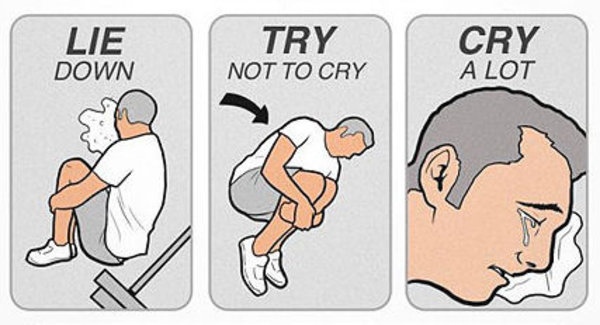

An accurate portrayal of reading Markus Zusak's The Book Thief 
As it says in the description, this is a simple story. Something else I really enjoyed about this book is how simplistic it is. Usually war novels make everything be Big and Important, but The Book Thief chooses to focus on the smaller things, the everyday life. It's a unique way of telling this type of story, but I think it is more effective than making everything be Big and Important; The Book Thief only dramatizes what needs to be, and even then, it's minimalized if it needs to be.

If you couldn't tell, I absolutely love this book. It's one of my all time favourite books ever, even though I have only ever read it once. I can't wait to read it again (whenever that may be). I truly recommend this book. It is touching and overwhelming and wonderful. It is a book that will stay with you for a long time after finishing it. I give The Book Thief by Markus Zusak 5/5

Wednesday, March 1, 2017

Stranded by Bracken MacLeod

From Goodreads:
Badly battered by an apocalyptic storm, the crew of the Arctic Promise find themselves in increasingly dire circumstances as they sail blindly into unfamiliar waters and an ominously thickening fog. Without functioning navigation or communication equipment, they are lost and completely alone. One by one, the men fall prey to a mysterious illness. Deckhand Noah Cabot is the only person unaffected by the strange force plaguing the ship and her crew, which does little to ease their growing distrust of him. 

Dismissing Noah's warnings of worsening conditions, the captain of the ship presses on until the sea freezes into ice and they can go no farther. When the men are ordered overboard in an attempt to break the ship free by hand, the fog clears, revealing a faint shape in the distance that may or may not be their destination. Noah leads the last of the able-bodied crew on a journey across the ice and into an uncertain future where they must fight for their lives against the elements, the ghosts of the past and, ultimately, themselves


I read this book immediately following The Terror, so maybe I would have enjoyed it a bit more had there been a book in between The Terror and this one, because they are both survival stories that take place in the Arctic on ships frozen in the ice. Regardless of that, this is a well-written book. It was in the horror section of the bookstore, but I wouldn't really classify it as horror so much as I would classify it along the lines of "adventure thriller mystery with a dash of horror". There are definitely horror elements to be found within the book, and there are tense scenes, but it is more a metaphysical mystery that questions reality, that just so happens to have horror elements within it.

This book is fine. The concept is great; I'm very intrigued by the testing of characters that are stranded in an isolated area with no access to communication. I enjoyed the set-up and the setting, but I found the big plot twist to be a bit out of left field and didn't really get tied up at the end. It had a kind of slapped-on, "Oh, OK!" sort of ending. The characters were OK, everything was just OK. It really got to be good in the middle section when tensions were high and fingers were being pointed. It had a very WTF twist somewhere in the middle as I mentioned, that didn't really get explained in a concrete way. I found the tension and contempt between the crew members and the main character Noah to be a bit forced. Even the tension and dislike between the captain (commander? I'm not too sure what Brewster's title is), who just so happens to be Noah's father-in-law and Noah himself was almost cliched, especially in the basis of the rivalry. While there was cliche to this aspect of the novel, it is also where most of the overall suspense stems from, and it does get better as the novel progresses. 

What I do like about this novel is how it addresses guilt and facing ghosts of the past, both of which have a large part to play here, especially after the surprise twist halfway through the novel. While the ghosts of the characters pasts are a bit more literal than figurative in this novel, it works for what MacLeod is aiming for with the overall theme of man-vs-self and man-vs-man. While it's not as effective as what Dan Simmons did in The Terror, it's still effective in this book, and it works for what the author is going for. Overall, this book is good. It had a great concept, and I really enjoyed the final, tense moments that we see on the ship when everything is coming to a (really violent) head, and I enjoyed the more philisophical and almost meta-physical approach that it takes. I enjoyed reading it, and it didn't take long to finish it. I'm giving Stranded a 3.5/5

The Terror by Dan Simmons

From back cover: 
The men on board the HMS Terror - part of the 1845 Franklin Expedition, the first steam-powered vessels ever to search for the legendary Northwest Passage - are entering a second summer in the Arctic Circle without a thaw, stranded in a nightmarish lansdscape of encroaching ice and darkness. Endlessly cold, they struggle to survive with poisonous rations, a dwindling coal supply, and ships buckling in the grip of crushing ice. But their real enemy is even more terrifying. There is something out there in the frigid darkness: an unseen predator stalking their ship, a monstrous terror clawing to get in. 

The word I would use to describe this book is chilling (aren't I witty?)

This was another whim book I bought at the same time I bought The Ballroom a few weeks back.

The title of this novel could refer to a number of different things. Is it referring to the name of the ship? Is it referring to the unseen predator? Is it referring to the nightmarish conditions the crew has to endure such as scurvy, harsh conditions, and the promise of not moving forward with their expedition? I personally think it's the latter, because the Arctic Circle is pretty dang terrifying.

It was odd reading this book, knowing more about the failed Franklin expedition now, than what was known when the book was written and published. For reasons beyond my knowledge, this type of history speaks to me, so I was really intrigued by the description. It is also one of the oddest hybrids I think I've ever come across - historical fiction and horror/supernatural. But it works. Mostly it's historical, but man is there tension even when the supernatural elements are absent. It's very clear that the author did his homework because the research done for this novel is intensive and it shows. It pays off really well.

While I did enjoy the supernatural elements of this book, the most suspenseful parts were the survival bits. As I mentioned, the Arctic Circle is not a place I'd like to be. Simmons' writing style is unique and works for this type of novel; it changes with perspectives. The more tense scenes had me looking over my shoulder and wondering if I was being watched, which is proof that a horror author is doing their job correctly. As one of the reviews that the book boasts, this book is unusual which is a good way to describe it. I've never read a book quite like this. Of course there have been other survival stories, enduring harsh conditions and the like, but none quite like this. I'm giving Dan Simmons' The Terror a 4.25/5

Tuesday, February 28, 2017

The Silver Linings Playbook by Matthew Quick

Goodreads Summary:
Meet Pat. Pat has a theory: his life is a movie produced by God. And his God-given mission is to become physically fit and emotionally literate, whereupon God will ensure a happy ending for him -- the return of his estranged wife Nikki. (It might not come as a surprise to learn that Pat has spent time in a mental health facility.) The problem is, Pat's now home, and everything feels off. No one will talk to him about Nikki; his beloved Philadelphia Eagles keep losing; he's being pursued by the deeply odd Tiffany; his new therapist seems to recommend adultery as a form of therapy. Plus, he's being hunted by Kenny G!

OK, show of hands, how many people didn't know that this was a book before it was a multi-Oscar winning movie? Me, too, until quite recently. When reading, I have a rule guideline that I try to follow: READ THE BOOK BEFORE SEEING THE MOVIE. When I saw the movie, I didn't know it was a book. I didn't know it was a book until four weeks ago when one of my best friends told me that it was one of her favourite books and insisted that I read it ASAP. So, I did. 

I loved how this book is written. It really does sound like someone is telling you a story of their life, complete with some miniscule details that don't really matter to the overall story, which adds to the realism, very unlike "cold" first person narratives that are very aloof and don't mention the little details that make the story endearing. Matthew Quick makes Pat a very likeable person and also a very alienating person at the same time. This book eloquently and heartbreakingly paints an accurate portrait of living with mental illness and methods of coping with different mental illnesses in everday life. What I really liked is that there was no Big Event like there usually is in these sorts of books; the film makes the dance competition that Pat and Tiffany participate in a Big Event, but is a very small event in the book. There is no one Big Event, rather a lot of small events in a big story, which is refreshing to see. It has a very minimized atmosphere.

This book is definitely a character-driven one rather than a plot-driven one. It was a short read, took me maybe a few hours to finish, and I really enjoyed seeing how everything would play out. For comparison, once I finished the novel, I popped in the movie adaptation, and while it is still a good movie on its own, it is not a good ADAPTATION. This was the first book I read on my reading week, and it was such a charming, endearing novel that I thoroughly enjoyed. I'm giving The Silver Linings Playbook a 4.5/5 because I wish I had read the book before seeing the movie. 

Also, P.S. Pat's book "reviews" are the greatest thing ever. 

The Ballroom by Anna Hope

From Goodreads: 
1911: Inside an asylum at the edge of the Yorkshire moors, 
where men and women are kept apart by high walls and barred windows,
there is a ballroom vast and beautiful. For one bright evening every week they come together and dance. When John and Ella meet, it is a dance that will change two lives forever.

Set over the heatwave summer of 1911, the end of the Edwardian era, THE BALLROOM is a historical love story. It tells a page-turning tale of dangerous obsession, of madness and sanity, and of who gets to decide which is which.


Like most of the books I buy these days, I bought The Ballroom by Anna Hope on a sort of whim. I was in Chapters a few weeks ago, just browsing for books to read over my reading week. It was the second book of four I read that wasn't for school on my reading week, the first being The Silver Linings Playbook by Matthew Quick (that review coming soon to a blog near you!). Right away upon starting the book, I felt instantly connected to the main character Ella and her plight inside an early twentieth-century asylum. Hope's prose is lyrical and rhythmic. The story provides an insight into how patients at an asylum were treated in the pre-World War I era, regardless of their mental health status, and you see that it might not be the patients that are the most troubled ...

Weekly in this asylum, men and women, who are forcibly separated, are selected to join together at the ballroom for weekly balls. It is here where our two protagonists Ella and John form their unbreakable bond and herein unfolds our love story in an almost epistolary form, with John writing letters to Ella, which are read to by her friend Clem (as Ella cannot read herself), which, if done correctly (as it is in this book) really pays off. Elsewhere in the novel is the main antagonist, Charles, who goes from a disgruntled and intense doctor and master of the band that plays at the weekly balls, to the deranged and deluded man obsessed with eugenics, raising the question of who the troubled ones really are.

I truly enjoyed this book. I tore through it in about a day and could not bear to put it down when I had to go to work. Hope's prose is beautiful and simplistic and does well in splitting up the perspectives between Ella, John and Charles, showing each side of the story from different perspectives, filling in the blanks. The latter part of the novel is both heartbreaking and uplifting as is the overarching message and theme of finding love where love cannot be seen. It is one of those books that cannot leave your brain. I loved reading this book, and I will definitely will be reading more of Anna Hope's novels in the future. This book easily became one of my all-time favourites soon after I finished reading it. I definitely recommend this book, especially to those who enjoy historical fiction and mental illness in literature, and I give it a 5/5

I'm back ... Sort of

Hi, everyone.

It's been awhile, hasn't it? Well, that's what university does for you. As predicted, I got super busy almost right out of the gate starting third year, and since then, I've had very little time to read and blog. But I'm here now. And I read about four books over my reading week, which ended back on Sunday. Mostly horror, but a few historical things in there as well. I'm trying to get more into the reviewing atmosphere for books, so I might join Net Galley or Book Look in the next little while so I can get more books to review.

I'm going to try and change the way I do business around here a little bit too and make it be a more professional looking blog, so I can go into a book-reviewing career of some sort. I'm not going to drastically change things, just polish it up a little bit. What I'm going to try to do is cross-post on Goodreads whenever I make a review, and post on Facebook and possibly Twitter once a review has gone live over here. I'm going to try and be a more active book-reviewer.

I'm hoping to get more reviews up, but it's assignment time coming up in the next little while. I only have a month and a bit left to go until I'm done third year, so I'm hoping to read a lot this summer and document what I read. While I am doing a summer course in the second half of the summer semester, it won't be an intensive 12-week affair. I don't have a class until 6pm tonight and it's 8:30 here right now, so expect something soon.

That's all for me right now. I'll have my first review up from reading week soon!

Sunday, October 9, 2016

The Road by Cormac McCarthy

From Goodreads/Back Cover
A father and his son walk alone through burned America. Nothing moves in the ravaged landscape save the ash on the wind. It is cold enough to crack stones, and when it snows it is gray. The sky is dark. Their destination is the coast, although they don't know what, if anything, awaits them there. They have nothing; just a pistol to defend themselves against the lawless bands that stalk the road, the clothes they are wearing, a cart of scavenged food - and each other. 

The book that started it all in the post-apocalyptic genre of novels. My god. I am HERE for this book. I loved it the first time I read it in one of my first year English courses (Truth, Lies and Storytelling), but I think I love it even more after reading it on my own terms. The atmosphere and world (or lack thereof) that Mr. McCarthy creates in this tense, weary, dead America after the end of the world is amazing. I love his simplistic way of storytelling. This is one of the best-written books I've read in a while. While it is simplistic in its storytelling method, it is a very dire situation that the two characters find themselves in. And there is a lot of grim moments throughout the book (the cannibal house scene alone is nightmare fuel) which adds to the direness and the realness of the apocalypse and survival methods that the few left have to employ in order to see tomorrow. Cormac McCarthy creates what could be a very realistic post-apocalyptic world, filled with grim scenes of death, lawlessness and situations that would be unimaginable in normal situations. But these are not normal situations that the Man and the Boy find themselves in.

I think, at its core, The Road can be seen as a love story between a father and son in a life-or-death, man-eat-man world. "Is the love they share the only love they have?" was one of the questions on the exam, and my response was, "After everything that has happened between the apocalypse and now, yes." While the Boy does have compassion for other people they come across, I think the only person he loves is his father.

One of the things that I enjoyed is the isolated tone that the novel employs. Even when the Man and his son come across people, there is still the feeling of isolation. Have they gone crazy from being alone for so long? What I'd really love to see in a novel, is a sole survivor of an apocalypse or plague come across other survivors after an undisclosed amount of time. That would be really interesting to see. I love how there's not really a singular man-vs-x theme in this. It sort of employs all three: man-vs-nature, -self, -man. It's mostly man-vs-nature, which works well, but it also employs the other two quite frequently as well, mostly man-vs-self. I really enjoy it when novels don't stick to just one.

The best thing that Cormac McCarthy does in this book is create the atmosphere. As I mentioned earlier, his end-of-the-worldbuilding is amazing, and really believable. I could totally picture the descriptions he has as being real in a world beyond ours. I think this book really helped the post-apocalyptic genre start to take off. I wish there were more books like this, as I love this genre, something that is not a secret on this blog.

I adore this book and I give it 5/5 stars. I'm very happy that I have my own copy in my collection now (the one I had in first year was very well-used and falling apart - but the bookstore still took it back at the end of the year).

Happy Thanksgiving to all my Canadian readers!