From Goodreads:
Childhood friends Patricia Delfine and Laurence Armstead didn’t expect to see each other again, after parting ways under mysterious circumstances during middle school. After all, the development of magical powers and the invention of a two-second time machine could hardly fail to alarm one’s peers and families.
But now they’re both adults, living in the hipster mecca San Francisco, and the planet is falling apart around them. Laurence is an engineering genius who’s working with a group that aims to avert catastrophic breakdown through technological intervention. Patricia is a graduate of Eltisley Maze, the hidden academy for the world’s magically gifted, and works with a small band of other magicians to secretly repair the world’s ever growing ailments. Little do they realize that something bigger than either of them, something begun years ago in their youth, is determined to bring them together—to either save the world, or plunge it into a new dark ages.
If Wes Anderson ever made a movie based on a book, I could very easily see him adapting this book. It's creative and imaginiative and just the right amount of quirky. Not so much that it's off-turning. I thoroughly enjoyed reading this book, and took my time with it, because it is not a book that you should read in one or two sittings over the span of a couple of hours. This book demands that you savour it, and savour it I did.
This is the first Charlie Jane Anders novel I've read, and it won't be my last. I loved everything about this book. It was funny, it was clever, and it was just so weird in the best possible way. But as weird and quirky as it was, it was also very real. Anders utilizes the idea of magical realism in this book a lot, and it works well for the story she is telling here. I could very easily imagine these events happening, even the magic-y stuff, since I am a believer in magics both small and big, noticed and unnoticed. The magical realism adds another level of charm and quirkiness to this book that just makes it that more compelling and readable. Like I said earlier, this book demands that you take your time with it, or at least, it made that demand of me. I read this book in little bits over the course of four days.
This book makes the claim that it is about love, life, and the apocalypse. It absolutely is. While it's an odd combination, Charlie Jane Anders' writing style makes it work really well so that it is realistic and compelling. Her writing style is unlike anything that I have read before; it's almost as if the narrator is having a conversation with the reader and uses terms such as "And then Patricia was like ..." which is very true to life. I loved seeing a departure from more aloof (for lack of a better word) narration style that you sometimes see in books like this. Her writing style added so much to the charm and quirkiness of the book. The writing style in All the Birds in the Sky was such a huge added bonus for me, and if it had been anything other than what it is, I probably would have enjoyed it less than I did.
The characters were well fleshed out and relateable. I feel like after reading 432 pages, I could very easily tell you about Patricia and Laurence and what makes them tick. I loved that the love in this book was both romantic love and platonic love. The characters in this book are very well-developed which is great because in order for a novel like this to work, you need to have compelling characters in order to tell the story correctly and in a unique way. The characters also brought a lot to the table, and also upped my enjoyability of this novel. Nothing is worse than a magical realism novel with less than compelling characters. Even the side characters were well-developed and interesting. I could read entire novels about the side characters that show up in this book.
All the Birds in the Sky is one of the most unique, charming, and quirky novels I've ever read. It has great characters, a compelling and interesting story, and a great and unique writing style. It is just the right amount of weird that it works and I'm so glad that it is weird and quirky because if it was anything else, this book wouldn't have been so enjoyable. I loved this book so much. I'm giving All the Birds in the Sky 5/5 - I can't wait to see what Charlie Jane Anders does next.
From Goodreads:
The crumbling summerhouse called Wild Fell, soaring above the desolate shores of Blackmore Island, has weathered the violence of the seasons for more than a century. Built for his family by a 19th-century politician of impeccable rectitude, the house has kept its terrible secrets and its darkness sealed within its walls. For a hundred years, the townspeople of Alvina have prayed that the darkness inside Wild Fell would stay there, locked away from the light. Jameson Browning, a man well acquainted with suffering, has purchased Wild Fell with the intention of beginning a new life, of letting in the light. But what waits for him at the house is devoted to its darkness and guards it jealously. It has been waiting for Jameson his whole life - or even longer. And now, at long last, it has found him!
It's a sign when it takes four days to finish a 180 page book.
The one thing I keep coming back to when I think about this book is how I wish it were longer than 180 pages.
I went into this book thinking that most of it would take place at the haunted house and it would be about an old haunted house, that the main character/narrator has to find the hidden meaning behind. It is ... for the last 50-ish pages (not counting the prologue). Most of the story is devoted to his upbringing, his strife-filled childhood and early adulthood, and his relationship with his father. That being said, I did really like the writing style that author Michael Rowe has in this novel. It had a real page-turning quality that I enjoyed. While I did take four days to finish this relatively short novel, whenever I was reading this book, I found I could not put it down. There are some really chilling moments during the "formative years" section which Michael Rowe does well.
I did enjoy reading about the main character Jameson "Jamie" Brown and his upbringing. He is no stranger to strife. I found him to be mainly sympathetic, but I found my sympathy for him waning by the end of the novel. I had so many unanswered questions about Jamie and about the other characters that are briefly featured in this novel. The main reason I wish this book was longer is to see more of the supporting characters and more of the creepy "mirror-friend" that shows up in his childhood, and then again at the very end. I wanted to see more of Jamie's relationship with his father, and I especially wanted to see what led him to look for the haunted house and eventually purchase it, despite the lunatic real estate agent.
The haunted house in question, however, doesn't show up in present time until near the very end, and then it is rushed and filled with cheap, cliche scares that can easily be found in a B-grade horror movie. I feel as though it was really rushed at the end. And it featured some of the most squirmy and squickish moments I've read - and not in a good way - about 30 pages before the ending. It would have been nice if the book were longer so that there was more set-up, explanation, and more of a cohesive conclusion that wraps things up more coherently.
Wild Fell is ultimately a mish-mash of great and OK at best. The writing is great for the majority of the book, but sort of falls apart in the latter section of the novel as it is reaching its close. While there are some chilling and creepy moments in the beginning and middle sections, and some in the concluding section, the conclusion was unfortunately kind of sloppy and rushed with some REALLY squicky and squirmish moments near the end. It would have been much better had Wild Fell been even 50 pages longer to have more of a set-up that would play into a better pay-off. I was looking forward to this book, but I was ultimately disappointed. I'm giving Wild Fell a 2.5/5 - it had some great writing and the "Jamie's Childhood" section was really well done, but it just fell apart and was super rushed at the end; I am positive that I would have enjoyed this a lot more if it had been slightly longer than 180 pages
From Goodreads
It is 2140.
The waters rose, submerging New York City.
But the residents adapted and it remained the bustling, vibrant metropolis it had always been. Though changed forever.
Every street became a canal. Every skyscraper an island.
Through the eyes of the varied inhabitants of one building, Kim Stanley Robinson shows us how one of our great cities will change with the rising tides.
And how we too will change.
This is a climate change novel that knows what it's talking about.
In this book, Kim Stanley Robinson creates a realistic future New York City 130 years from now. Things are mostly the same as they are now. It's not a gritty, barren dystopia that creates the backdrop Quite the opposite; there is an underlying feeling of hope in this novel, and a feeling of inspiration to do better by the planet in regards to its ecologies, economies, policies, and societies. There is a clear agenda to create awareness for our collective and individual "footprint".
This is my first Kim Stanley Robinson novel, and I quite enjoyed it. It is easy to read and follow, and unlike most futuristic "dystopian" novels that I read these days, it was easy to connect to the story, mainly because it follows something that is mostly tangible (I mean, look at what is happening in Texas right now). Kim Stanley Robinson creates a realistic, imaginative, and compelling future, one that is not so different from our present, which is what I think makes it so compelling.
Climate change or global warming or whatever it is you want to call it is a very real thing, and it could have been very easy for Robinson to become preachy, dense, and beating you over the head with his message, it hardly ever does, and when it does, it's simply to drive the point further. While some characters are less oblique in their references than others, Robinson's narrative never gets too self-indulgent or self-important. He tells his piece in a convincing, compelling way.
One of the many highlights of this book is the characterization. All of the characters bring something to the table in New York 2140. They come from all walks of life, so each character has a fresh, unique take at the subject at hand. While I did like some characters more than others, each character was well-developed, and was compelling. Not one of the characters detracted from the overall story or message that Robinson was putting forward. The neat thing about this book is how it is separated into different narrative section, each chapter being from a different perspective, yet all of the characters interact in each chapter. It was a neat way of telling the story, and you can see how these events can and do affect everyone. The storylines of the characters converge almost instantaneously to create one complex, layered storyline.
New York 2140 is a very engaging, compelling read. Kim Stanley Robinson has created a very realistic vision of what the future could be like if climate change is not addressed. While there were some moments where the narrative got a bit too preachy, it was necessary for the narrative and the message to be properly conveyed. After hemming and hawing over what rating to give it, I decided to give New York 2140 5/5 - it should be required reading in 2017 and the years to come to avoid the future that Kim Stanley Robinson has envisioned.
From Goodreads:
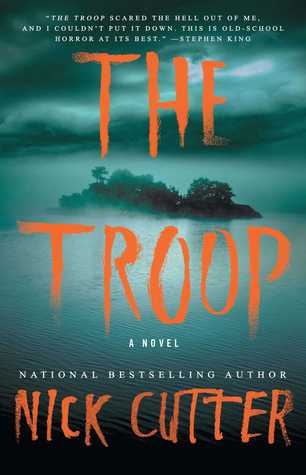
Once every year, Scoutmaster Tim Riggs leads a troop of boys into the Canadian wilderness for a weekend camping trip—a tradition as comforting and reliable as a good ghost story around a roaring bonfire. But when an unexpected intruder stumbles upon their campsite—shockingly thin, disturbingly pale, and voraciously hungry—Tim and the boys are exposed to something far more frightening than any tale of terror. The human carrier of a bioengineered nightmare. A horror that spreads faster than fear. A harrowing struggle for survival with no escape from the elements, the infected…or one another.
You know this is going to be good when the King himself blurbs the book saying it "scared the hell out of [him]", and Jesus Christ on toast, was this scary. This might be the scariest book I've read in a while, possibly ever.
This is what I'm always looking for in contagion novels: a source of the contagion (because then there are so many more questions), the first contact with the contagion, and then the fallout from that contagion, done so in a really creepy, scary way. An added benefit in this book is the fact that they are on an uninhabited island with little way of contacting the mainland, so that added to the tension and horror-ness of the book. Because, how un-scary would it be if they had their phones and were in a really densely populated area and could alert the authorities at any time. AND, to top it all off, the threat of a treacherous storm is always looming in the background. The perfect combination for this book. I probably should have waited to read this in October, around Halloween, but I really wanted to read The Troop as soon as possible.
The tapeworms in this book (the bioengineered nightmare) are so creepy. The whole organization behind it reminded me of MKUltra a little bit, only a lot more ... squrimy (pardon the pun). A piece of advice: don't eat while reading this book, or read it right before going to bed. This is one of those books that gets your paranoia going strong. I think for the next little while, I will be suspicious whenever I am really hungry.
Nick Cutter proves once again that he is a master in writing a horror story that is compelling, dark, and most importantly, SCARY. And not just scary-scary, but painfully scary. This book is not for the squeamish or faint of heart. This is a body horror meets contagion, meets survival, meets an almost MKUltra organization kind of scary. I've never seen body horror done in this way before. Not only does Nick Cutter show the actual contagion in a really scary way, he shows the fallout from the contagion and the risk of it spreading in a really scary way. A mistake I made while inhale-reading this last night was eating while reading it at one point, hence why I gave that piece of advice about not eating while reading this book at the same time.
I thought it was really neat how Nick Cutter paid homage to Stephen King's first novel Carrie in The Troop by way of using interviews and newspaper articles to advance the plot. The plots of both these books could not be more disparate and far away from each other in terms of what goes on and what the final outcome is in each book. It worked really well in Carrie, and it works really well for The Troop.
The characters were all different. Teenage boys are scary to begin with, but this was on a whole other level. This was on a Lord of the Flies level of how society crumbles and how people turn on each other when the chips are down. At first I was a bit skeptical about how unlikeable (most of) the boys in this book were, but it worked to the book's advantage. It added to the overall horror, and by the end of it, you are sympathetic for even the most unlikeable of the characters (except, perhaps, with the villainous character). Even though some of them are unlikeable, they are still complex, and while they are horrible people some of them, they are great, well-developed characters and add to the amazing study that Nick Cutter has going on about the breakdown of a society in the event of an outbreak of contagion. It was really compelling. The balance between the good people and the less good people was a good one, and as the story progressed, you see that not all of the less-savoury ones are actually like that.
The Troop is a fantastic novel. It kept me up late because I couldn't put it down. With a squirmy and painfully scary horror, this book was everything I wanted it to be. The writing is amazing, the horror never lets up, and the characters work well for the story. In paying homage to Stephen King's Carrie though story-telling methods, Nick Cutter tells his own, completely different, story wonderfully. I loved every page of this book. It was an interesting study on how civilization, no matter how small, can break down in the event of a disaster. The Troop definitely gets 5/5 - this book is masterfully, painfully scary.
From Goodreads:
Not far in the future the seas have risen and the central latitudes are emptying, but it’s still a good time to be rich in San Francisco, where weapons drones patrol the skies to keep out the multitudinous poor. Irina isn’t rich, not quite, but she does have an artificial memory that gives her perfect recall and lets her act as a medium between her various employers and their AIs, which are complex to the point of opacity. It’s a good gig, paying enough for the annual visits to the Mayo Clinic that keep her from aging.
Kern has no such access; he’s one of the many refugees in the sprawling drone-built favelas on the city’s periphery, where he lives like a monk, training relentlessly in martial arts, scraping by as a thief and an enforcer. Thales is from a different world entirely—the mathematically inclined scion of a Brazilian political clan, he’s fled to L.A. after the attack that left him crippled and his father dead.
A ragged stranger accosts Thales and demands to know how much he can remember. Kern flees for his life after robbing the wrong mark. Irina finds a secret in the reflection of a laptop’s screen in her employer’s eyeglasses. None are safe as they’re pushed together by subtle forces that stay just out of sight.
This book is going to be tricky to review. Oddly enough, it kind of reminded me of Orphan Black a little bit. It might have been the chapter titles and the light bio/cyber-punk vibe that was going on.
While I didn't dislike it, this book didn't really grab my attention all the way. I was interested in the concept and the world-building and the attention to detail that Zachary Mason achieves in this outing.
This book's greatest achievement by far is the writing and the world-building. The writing is really disorienting at times, which works well for a book like this. Zachary Mason has a strong writing voice, and he builds his near-future world with ease. He's a really gifted writer in this regard. I could very easily imagine this happening; usually with SF novels of this type, there's usually at least one moment where I say "that wouldn't happen!" That didn't happen with this book. His writing style is easy to follow and he creates a world just so disparate from our own that it works. I liked that about this book. If I was judging this book based solely on the writing style, it would for sure get a 4+ rating from me.
Going off of that, the attention to detail for the bots, AIs and gizmo-y stuff was amazing. I think Zachary Mason has some background in I.T. or computer programming, which comes in handy for this world. I'm not super-into this sort of stuff, but I always like to broaden my horizons when it comes to reading. It was rather dense for my liking at times which took me out of it a little bit, and I found myself skimming when it got to be too dense for me. If it was drawn back a few notches, my enjoyment level would have gone up a little.
While the writing style and world-building was excellent, I felt like the characters were not as developed as they could have been. I felt sympathy for them in their plights at certain moments, but I didn't really notice any defining characteristics, and they didn't really grow as much as people or characters. Since I'm all about characters and finding what makes them tick, not having that in this book was a let-down, and was ultimately why I didn't enjoy it as much as I wanted to.
All in all, I was kind of disappointed by this book. While it wasn't bad, it just didn't get my attention, the characters were under-developed, and the narrative got super-dense at times. I also found that the storylines didn't converge until the very end. I know some people who would love this book. The writing style and world building were incredible and Zachary Mason has a real talent for writing and creating realistic future worlds, but it really wasn't my cup of tea on the whole. I'm going to give Void Star 2.5/5 - it just didn't work for me.
From Goodreads:
Two magicians shall appear in England.
The first shall fear me; the second shall long to behold me...
The year is 1806. England is beleaguered by the long war with Napoleon, and centuries have passed since practical magicians faded into the nation's past. But scholars of this glorious history discover that one remains: the reclusive Mr Norrell whose displays of magic send a thrill through the country. Proceeding to London, he raises a beautiful woman from the dead and summons an army of ghostly ships to terrify the French. Yet the cautious, fussy Norrell is challenged by the emergence of another magician: the brilliant novice Jonathan Strange. Young, handsome and daring, Strange is the very opposite of Norrell. So begins a dangerous battle between these two great men which overwhelms the one between England and France. And their own obsessions and secret dabblings with the dark arts are going to cause more trouble than they can imagine.
This is a long one. The copy I have is 846 pages long.
Jonathan Strange & Mr Norrell is a unique book in that it was written in the twenty-first century, yet reads as if it was written in the nineteenth, something the author did deliberately. It almost reads as a love letter to the writers and the literature of the nineteenth century. It is a pastiche of the works of the time in which this novel takes place. It was an enjoyable callback to the novels of the time, even down to the writing style and use of words in the way they would have been used (i.e.: chuse, surprize).
This book is not a quick read. I started this book on August 7, and it is now August 20, so just one day shy of two weeks. This is a novel that demands you take your time with, which is fine. I feel like in this case, it's better to take your time with it rather than inhale-read it. That way you get more out of it and things are not so rushed. The thing about this book is that if you don't take your time and speed-read your way through, you miss tidbits of information. There are plenty of footnotes in this book (I'll get more into that later), and they involve pivotal information so it's best that you read them too. While the page count is a bit daunting, I think it needs to be this long so Susanna Clarke can convey and get across everything she needs to. All that being said, however, there were times were this book ... wandered and strayed a little bit.
This book was good, not great, in my opinion. I liked the concept and thought the characters were fine. Clarke has a strong writing voice, and her attention to detail is impeccable. The number of footnotes and references is astounding. I could have done with fewer or shorter footnotes (some of them go on for a few pages), but again, I think ultimately, they were necessary for the type of story she was aiming for. The wit is there, it's well-detailed, and has a great concept. Alternative history is something that always intrigues me, and she does well in making hers work.
People either love this book or hate it. I think it all boils down to taste. I liked this book well enough, I thought it was fine, but I liked By Gaslight better. It has some great observations, great writing, and excellent attention to detail. The backstory in this is incredible, and I have to give Susanna Clarke major kudos for mapping out a meticulous backstory with such rich detail. That for me was the highlight of this book. If you like slow, meandering novels with a lot of backstory, then you will probably like this book. As I said, this is a book that deserves time and attention and should be read slowly.
Ultimately Jonathan Strange & Mr Norrell didn't pull me in as much as I wanted it to. While the writing, concept, and detailed history/background that Clarke created were all incredibly meticulous and sharp, it didn't completely hold my attention all the way through. I found it was a bit too long to get to the climax, and could have done without as many footnotes as there are, while at the same time, I understand why it is this long, as it covers a decade or more of time. I liked how she paid homage to the writers of the nineteenth century, which made it all the more atmospheric. I am going to give Jonathan Strange & Mr Norrell 3.5/5 - I thought it was fine, and if you like books like this, you would probably enjoy this book.
From Goodreads:
A trio of mismatched mercenaries is hired by a young woman for a deceptively simple task: check in on her nephew, who may have been taken against his will to a remote New Mexico backwoods settlement called Little Heaven. Shortly after they arrive, things begin to turn ominous. Stirrings in the woods and over the treetops—the brooding shape of a monolith known as the Black Rock casts its terrible pall. Paranoia and distrust grips the settlement. The escape routes are gradually cut off as events spiral towards madness. Hell—or the closest thing to it—invades Little Heaven. The remaining occupants are forced to take a stand and fight back, but whatever has cast its dark eye on Little Heaven is now marshaling its powers...and it wants them all.
Micah Shughrue is the first person I would choose when fighting off a team of creepy kids, evil monstrous entities that want your children, and religious fanatics.
This book is the second Nick Cutter I've read, after The Deep. I found The Deep to be scarier in a psychological sense, which plays into the abject and the fear of the unknown. This one is still psychologically scary, but it's less so than The Deep because you (kind of) know what the monster is by the end. This book read like a 1980s Steven King novel, especially in the themes and imagery it utilizes (evil children with some supernatural abilities, religious fanaticism, etc). There are many squirmy moments throughout, especially with the main villain Amos Flesher. The only thought that goes through my head when I think about him is EWWWWWW. So creepy and sick.
One of the things that this book does well is bring in connections from both reality and fairy-tales. The monster that shows up throughout the book can be seen as an inverted Pied-Piper. Flesher and the commune of Little Heaven itself are very clearly interpretations of the Jonestown massacre, right down to the drinking of the Kool-Aid. I haven't had Kool-Aid since I was 9, but I don't think I'll ever have Kool-Aid again in my life after reading both this book and the description of the Jonestown Massacre. Nick Cutter really did his research with this.
I loved the main quartet of characters. They were so flawed and very well-written. It wasn't your typical good-vs.-evil fight. They had great chemistry and it was great that they didn't all get along. Each of the main three were flawed yet sympathetic in one form or another. We see these characters over a span of many years, and they always bring something to the table. As I said, they're not considered to be "good" but they're not "bad" either. They're flawed and they have demons and they're just doing everything they can to survive a scary cult.
Cults frighten me. Period, end of story. Nick Cutter took the frightening elements of cults and turns it up to thirteen. There were still very many squicky moments in here, make no mistake. This is a Nick Cutter novel after all! But what Nick Cutter did here was so imaginitive, very realistic and on hyper-drive to play into the frightening parts of cults. (which parts aren't frightening though?) His writing here is a lot like a Stephen King novel, not ripping off, but paying homage to him and other great horror novelists.
I liked Little Heaven, not in the same way that I liked The Deep. This book is psychologically scary, but not scary in the way that his other books are. This book plays into the grotesque a lot with the evils that are at play, which I always enjoy in a horror novel. His portrayal of a religious cult with fanaticism to the Nth degree added a lot to the horror. Paying homage to the horror novels of the 1980s, this book had great characters, a clear presentation of what was at stake, and creepy villains. While it didn't scare me in the same way that The Deep scared me, I still had a good time with Little Heaven, and I'm going to give it a 4/5.