Monday, July 31, 2017

The Woman in Cabin 10 by Ruth Ware

From Goodreads:
In this tightly wound story, Lo Blacklock, a journalist who writes for a travel magazine, has just been given the assignment of a lifetime: a week on a luxury cruise with only a handful of cabins. At first, Lo’s stay is nothing but pleasant: the cabins are plush, the dinner parties are sparkling, and the guests are elegant. But as the week wears on, frigid winds whip the deck, gray skies fall, and Lo witnesses what she can only describe as a nightmare: a woman being thrown overboard. The problem? All passengers remain accounted for—and so, the ship sails on as if nothing has happened, despite Lo’s desperate attempts to convey that something (or someone) has gone terribly, terribly wrong…

Oh, boy ...

Nothing will ever be able to top the contempt and dislike I have for The Ship, but boy does this come close.

This review may be an unpopular opinion. The more I think about this book now that I'm finished, the more annoyed and angry I am at myself for reading it.  

I tried to like this book, I really did. The premise is interesting, and that was ultimately what drew me in. It looked like a modern re-telling of Agatha Christie's novels such as Murder on the Orient Express taking place on a boat rather than on a train. While this book tries to replicate certain specifics of Christie's novels, it lacks all the charm, excitement and other things that made Agatha Christie's novels tick. 

I felt like I couldn't get into this book. A great deal of that is thanks to INSUFFERABLE characters, specifically the narrator and main character Lo. She's not as bad as Lalla in The Ship, who will always be the worst character ever written, but if there was a list of the top ten worst characters in literature, I would put Lo Blacklock somewhere on there, probably within the top five. She is so dumb, rude, demeaning, and doesn't think before she speaks or acts. Her response to most things is to turn to drink and pills. She is so dumb and so mean-spirited, it made me want to shake her. It got to the point where I was rooting for the killer to win. So she could be Lalla's older sister the more I think about it. Another big con was how nothing really seemed to "happen". Like there were events and everything, but nothing really seemed to connect or be part of an overall story arc. The opening 30ish pages have nothing to do with the rest of the novel, but I guess it was pivotal to determine that Lo was on edge.  I still say that it should have been cut out entirely.  The side characters existed solely for expository purposes and not much else.

At its core, it's not overly exciting and drags often. There are so many plot holes both with the plot itself and with the characters, which also takes me out of the narrative I never felt scared or nervous, and I guessed the ending pretty early on. It was too convoluted for its own good and that's really disappointing because the blurb makes it sound so exciting and grim and claustrophobic, but it wasn't. I didn't feel any suspense whatsoever. It wasn't poorly written per se, but it wasn't anywhere close to being what I would describe as well-writen either. I saw the same descriptions and scenarios page after page, page after page, whether it be Lo self-medicating, reacting, speaking to other characters, or doing something silly that only further incriminates herself. The ending was so implausible, the more I think about it, the more it annoyed me.

In conclusion, don't read this book. The Woman in Cabin 10 featured insufferable characters, implausible, hole-ridden plots, events that didn't lead anywhere, and was all-around boring and repetitive. It could have been so well-done and suspenseful, but it wasn't. You know it's bad when you start rooting for the killer. In any case, while I didn't like this book very much, it still had an interesting premise and had a few good moments of writing. But, the more I thought about it after I finished, the more I dislike it and find problems with it. I'm going to give The Woman in Cabin 10 a 1/5 - like I said, nothing can top my dislike for The Ship, but this is a good contender for runner-up.

Sunday, July 23, 2017

Station Eleven by Emily St. John Mandel

From Goodreads:
Kirsten Raymonde will never forget the night Arthur Leander, the famous Hollywood actor, had a heart attack on stage during a production of King Lear. That was the night when a devastating flu pandemic arrived in the city, and within weeks, civilization as we know it came to an end. 

Twenty years later, Kirsten moves between the settlements of the altered world with a small troupe of actors and musicians. They call themselves The Traveling Symphony, and they have dedicated themselves to keeping the remnants of art and humanity alive. But when they arrive in St. Deborah by the Water, they encounter a violent prophet who will threaten the tiny band’s existence. And as the story takes off, moving back and forth in time, and vividly depicting life before and after the pandemic, the strange twist of fate that connects them all will be revealed.


This is the most undramatic post-apocalyptic/contagion novel I've read. It's very matter-of-fact in its doom. Instead on focusing on the pandemic that wipes out most of humanity, it focuses on the people who survive and try to live in the aftermath, spanning decades. While it's undramatic in tone, it also puts into perspective how awful it would be to have to endure an epidemic and survive instead of live (there is a massive difference). Oddly, or not oddly, enough, the work of Shakespeare survives the pandemic, when so many other common, day-to-day things die out with the pandemic. This book is brilliant.

Station Eleven follows multiple characters throughout the years that this book spans. In doing so, we get perspective from and about the characters. The event that this book starts with doesn't really have to do with the rest of the plot as a whole (besides degrees of separation), you see just how lucky Arthur Leander was to have died of a heart attack given what is about to happen. We see later on how long the other cast members last in the pandemic. We see through different time jumps, what happens to each character at different points through (and before) the decades-long event. How interesting it is that the concept of time is one of the first things to go. Oh, sure, they're still keeping time, but not nearly in the same way that it was kept pre-flu epidemic.

The writing style in this book, as I have mentioned, is undramatic. While there are dire circumstances, and St. John Mandel notes the direness of the circumstances, it's not sensationalized like other survivalist and speculative fiction novels are. This is a book about people and how people live and survive in the hardest of conditions. While it's undramatic in writing style, it is never bored or boring. Quite the opposite; the undrama in the tone gives the book an extra emphasis on character and how civilization may come to its end as we know it. It's kind of like if Cormac McCarthy's The Road (one of my all-time favourites) had a younger sibling that was less grim.

I was also really jazzed to see that this book takes place mostly in Toronto. I knew where everything was that she described in this novel. That, combined with the easy writing style, it was easy to imagine where things were going down. It's always cool to see things happening in your home province.

I loved this book so much. I inhale-read it as fast as I could; I didn't want to put it down. It gives an intriguing look into what would happen after an epidemic. I like contagion novels, but I had never read one quite like this, where the contagion is just the McGuffin, and the main focal point is on the survivors. Well-written with well-rounded characters and a very interesting concept, Station Eleven shows the resilience of people in dire circumstances and paints a very realistic portrait of what would happen if civilization collapsed following a global epidemic. Station Eleven for sure gets 5/5 - I highly recommend it to all.

Saturday, July 22, 2017

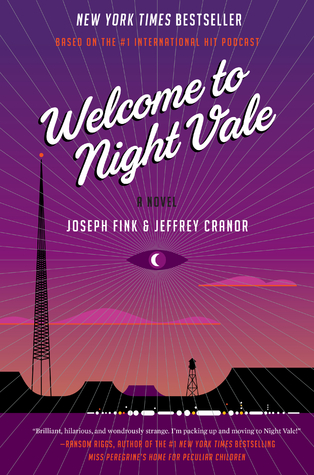
Welcome to Night Vale by Joseph Fink and Jeffrey Cranor

From Goodreads:
Nineteen-year-old Night Vale pawn shop owner Jackie Fierro is given a paper marked "King City" by a mysterious man in a tan jacket holding a deer skin suitcase. Everything about him and his paper unsettles her, especially the fact that she can't seem to get the paper to leave her hand, and that no one who meets this man can remember anything about him. Jackie is determined to uncover the mystery of King City and the man in the tan jacket before she herself unravels.

Night Vale PTA treasurer Diane Crayton's son, Josh, is moody and also a shape shifter. And lately Diane's started to see her son's father everywhere she goes, looking the same as the day he left years earlier, when they were both teenagers. Josh, looking different every time Diane sees him, shows a stronger and stronger interest in his estranged father, leading to a disaster Diane can see coming, even as she is helpless to prevent it.

Diane's search to reconnect with her son and Jackie's search for her former routine life collide as they find themselves coming back to two words: "King City". It is King City that holds the key to both of their mysteries, and their futures...if they can ever find it
.

"A friendly desert town where the sun is hot, the moon is beautiful, and mysterious lights pass overhead while everyone pretends to sleep. Welcome to Night Vale."

Welcome to Night Vale is based on the absurd and bizarre podcast of the same name created and written by Joseph Fink and Jeffrey Cranor. It is a podcast that I've been listening to since 2015 (and I'm still so woefully behind), and it's so weird. Trust me, that's the highest compliment you can give Night Vale. I didn't read the summary of this book before reading it, so I went in thinking it would be more of a guidebook to the small desert town. 

While this book wasn't what I expected content-wise, it was still a really interesting, funny book that I think would work really well as an episode of the podcast. I think it is a lot more enjoyable if you have listened to, and are a fan of the podcast itself as there are many in-jokes and references and characters that wouldn't make much sense without context. It's very hard to explain Night Vale to someone who hasn't listened to it or even heard of it. I remember trying to explain it to my brother and his now-wife a few summers ago, and my explanation of the podcast didn't do it justice. I don't think I sold them on it.

This book, like the podcast, has a really absurd, almost abject sense of humour. It read the way I imagine the podcast scripts would read (they have published the scripts in book form, which I may get just to have). The story works well, and it adds context to more minor characters, who come to the forefront in this book. Of course, we still get Cecil and Carlos in this book, and the way they utilize Cecil's role as the voice of Night Vale is really clever. We get more context on characters such as John Peters - you know, the farmer? as well as Old Woman Josie and the Man in the Tan Jacket. The main characters are well-developed and it's great to see them more fleshed out, and see who they are besides a mention on Cecil's broadcasts. The story is really compelling and funny in most parts. I see this as being more of a companion to the podcast rather than it's own thing.

The podcast has this odd charm to it that is hard to replicate in a convincing way, and the novelization of it recreates the charm and humour really well. It isn't quite as charming or odd as the podcast (nothing can replicate that), but it's pretty close. This book admits to all the surrealism that happens in the small desert community in such a Night Vale-ian way, it's great.

Welcome to Night Vale is a great book companion to an outstanding podcast. It replicates the oddness and humour just right. None of the jokes or references outstay their welcome. This book is well-written and has great usually side characters at the forefront. There's another novelization coming out in October of 2017 (three months from when I'm writing this) which I will read. I think this book works better if you have heard the podcast, but it also lends itself to people who haven't heard the podcast yet and can work as a stepping stone into the podcast. This is just a taste of what the podcast is like, because there's no way you can replicate hours upon hours of content (approximately 75 episodes had aired when this book was first published). I'm going to give Welcome to Night Vale the novel a 4/5, and Welcome to Night Vale the podcast a 5/5. I highly recommend either or both, especially if you're into surrealist, abject, and weird humour.

"And as always, listeners, good night, Night Vale. Good night."

Tuesday, July 18, 2017

Labyrinth by Kate Mosse

From Goodreads:
July 1209: in Carcassonne a 17-year-old girl is given a mysterious book by her father which he claims contains the secret of the true Grail. Although Alais cannot understand the strange words and symbols hidden within, she knows that her destiny lies in keeping the secret of the labyrinth safe ...

July 2005: Alice Tanner discovers two skeletons in a forgotten cave in the French Pyrenees. Puzzled by the labyrinth symbol carved into the rock, she realises she's disturbed something that was meant to remain hidden. Somehow, a link to a horrific past - her past - has been revealed.


I WANT TO GO BACK TO CARCASSONNE AND THE LANGUEDOC REGION.

Ahem.

I was in the Languedoc region of France in May of 2015, and this book has made me yearn for it. Kate Mosse's descriptions took me right back to the day that I visited Carcassonne's walled city. 

Medieval France is my jam, so I had a really good time with this book. It's historical fiction mixed with adventure, mixed with mystery, and a bit of romance added into the mix. It's well-paced and each narrative doesn't outstay their welcome. I was hooked almost instantly with this book. I liked how Mosse split up the POV between multiple characters - it mostly follows thirteenth century Alais and twenty-first century Alice, but it follows the people around them, as well - it kept the story flowing, and you got a feel for everyone's motivations and intentions. I did find some of the "villainous" characters to be a bit too villain-y. If they were men, I could picture them twirling handlebar mustaches and laughing maniacally. But, by the end of it, I was rooting for the two heroines to succeed.

The history in this book, while fictionalized for the purpose of the story, is really well-researched. Since I'm a medievalist, I knew a lot about the Crusades, castle-building, Cathars, and the overall history of France as a whole. Kate Mosse uses her research well to her advantage, and it works well for the story she is telling with this book. 

Kate Mosse creates a very intriguing world, and her writing style is unique. The world she has created in this book is so intertwined, and the payoff when you realize the connection between the two lead characters at the end. The set-up and payoff are done wonderfully and seamlessly. There are a few editing quibbles I have, mainly to do with grammar. While it was nice to see French scattered in there, it was kind of jarring, especially when it comes out of nowhere. What she does is have a character say something in French, and then repeat it in English, which seems redundant, but if there hadn't been a translation, it would have been frustrating.

Labyrinth is basically everything I wanted in a historical fiction book. It has well-researched history, which has been tastefully fictionalized. The two leading women are characterized well and they are easy to relate to. The story snagged me in very quickly, almost instantly. While there are a few nitpicks I have with a few of the minor characters and editing, they are not significant. I loved reading this book, and inhale-read it, reading 65% last night and 35% this morning. I'm going to give Labyrinth a 4.5/5. It was really well-done, and if you're a fan of medieval history or historical fiction, you will like it. Now to go research flights to Southern France.   

Sunday, July 16, 2017

The Deep by Nick Cutter

From Goodreads:
A strange plague called the ‘Gets is decimating humanity on a global scale. It causes people to forget—small things at first, like where they left their keys, then the not-so-small things, like how to drive or the letters of the alphabet. Their bodies forget how to function involuntarily. There is no cure.

But far below the surface of the Pacific Ocean, a universal healer hailed as “ambrosia” has been discovered. In order to study this phenomenon, a special research lab has been built eight miles under the sea’s surface. But when the station goes incommunicado, a brave few descend through the lightless fathoms in hopes of unraveling the mysteries lurking at those crushing depths…and perhaps to encounter an evil blacker than anything one could possibly imagine.


Nothing is scarier than the ocean.

This book can be described as harrowing, claustrophobic, and flat-out scary. Save for when I read Penpal, I don't know when I've been more scared while reading a book, which is a very good thing for a horror novel. Nick Cutter has created a world filled with realism and terror. The concept is something that could actually happen (the 'Gets part especially). While I was thinking that the illness would play a larger part in the overall story, and be more prevalent in the story, it was mainly the Macguffin for the plot and propelled the story forward. This book takes base fears that many people have and turns it on their heads; they don't go fast and furious right away, but it is not a slow burn either. I don't think I'll ever look at children's treasure chests in the same way.

The characters are well-developed. Two of the characters are estranged brothers, and you understand right away why there is an estrangement. What Nick Cutter has done so well in this book is make every character unreliable due to the nature of the underwater research lab, which ties in well to the horrors in the deep (pardon the pun). Despite this, the characters are easily-relatable and you sympathize with them, hoping they get out OK. I'm still planning on writing a book in which the dog lives.

Nick Cutter is a very skilled writer. He has written one of the most scariest novels I think I have ever read (and I have two other books by him on my TBR shelf). He moves from "slightly creepy" to "mindscrew" at the drop of the hat. He toys with every element of the genre in a suffocating way that plays well with both the grotesque and the abject. In addition, Nick Cutter has done his research for this book, and it works well. This book is really uncomfortable and haunting, and it makes you feel like you're really there. 

The Deep is by far one of the scariest books I've ever read in my life. This book gave me so many goosebumps and put my hair on edge. It's definitely a "sleep-with-the-lights-on" kind of book. It very easily portrays many base fears, especially fear of the bottom of the ocean. It's very well-written, with sympathetic characters. There were many instances of the grotesque and the abject, which added to the overall terror of this book. I'm definitely giving The Deep 5/5, and I can't wait to get into Nick Cutter's other books. 

Saturday, July 15, 2017

This House is Haunted by John Boyne

From Goodreads:
Set in Norfolk in 1867, Eliza Caine responds to an ad for a governess position at Gaudlin Hall. When she arrives at the hall, shaken by an unsettling disturbance that occurred during her travels, she is greeted by the two children now in her care, Isabella and Eustace. There is no adult present to represent her mysterious employer, and the children offer no explanation. Later that night in her room, another terrifying experience further reinforces the sense that something is very wrong.
 
From the moment Eliza rises the following morning, her every step seems dogged by a malign presence that lives within Gaudlin’s walls. Eliza realizes that if she and the children are to survive its violent attentions, she must first uncover the hall’s long-buried secrets and confront the demons of its past


The opening line of this book piqued my interest. Ghost stories intrigue me, and I like the authors (Charles Dickens, Charlotte Bronte) that author John Boyne was paying homage to. This book has a really good concept, and it was a good read, but I didn't find it that scary. 

I found it exciting, but not scary. It's definitely more of a plot-driven novel and less a character-driven one. This isn't a book that will have me up half the night wondering if my house is haunted or has spectral visitors. I wished that it was more scary, or at least that Eliza found things to be scarier than they were. I know it's supposed to be paying homage to the Gothic novels that were so fond of having characters be unnervingly calm in their description of supernatural things, but it would have been nice to see Eliza react more to scary things that were happening than what we got. It was teetering on being one-dimensional. If Eliza wasn't scared of what was going on, why would I be? 

This being said, however, John Boyne has a strong narrative voice, and has a great writing style. He pays homage to the Victorian and Gothic authors, while also having his own narrative flair and style that makes for a unique hybrid of old and new. He is a good writer, which shows through in this book, and is one of the highlights of the novel.

Unlike Dickens' novels or books by Charlotte Bronte, This House is Haunted didn't take me very long to read once I got into it. It was a relatively short and quick read, and things moved quickly. As I said, it wasn't all that scary. It was nothing new or surprising, just your general run-of-the-mill Gothic tropes. The explanation for the twist kind of fell flat for me, and the lack of public curiosity about a high turnover rate of governesses was eyebrow-raising. In Jane Eyre, I was genuinely afraid of the madwoman in the attic. I wasn't really afraid of what came in This House is Haunted. Sure, I was curious about how it would all turn out, it wasn't all that scary. 

All in all, This House is Haunted is fine. It has an interesting concept, and I liked the homages that the author made to Victorian and Gothic writers. It was a quick book to get through, and there are some interesting moments. John Boyne is a good writer with a unique writing style, paying homage to writers of the Victorian era, while also creating his own narrative voice. That being said, it wasn't scary enough for my tastes, and I didn't really connect to the narrator on any level. I'm going to give This House is Haunted a 3/5 - it was good, and has a lot of potential, but it needed a bit more.

Tuesday, July 11, 2017

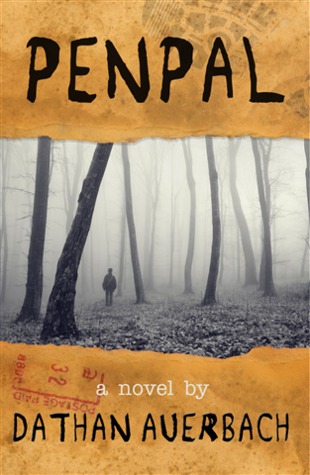
Penpal by Dathan Auerbach

From Goodreads:
How much do you remember about your childhood?

In Penpal, a man investigates the seemingly unrelated bizarre, tragic, and horrific occurrences of his childhood in an attempt to finally understand them. Beginning with only fragments of his earliest years, you'll follow the narrator as he discovers that these strange and horrible events are actually part of a single terrifying story that has shaped the entirety of his life and the lives of those around him.


I super inhale-read this. 

This book sort of reminded me of Slenderman, which I think originated in the same way this story did, on reddit as scary stories before becoming more popular. For a while, I thought the bad guy would be the Slenderman himself. 

I read this over the course of a day. At first I didn't think this was a super-scary read, but more unsettling. But the more I read, and the more I thought about it when I wasn't reading it, I became more jumpy and scared. This is a book that you think about when you are not reading it. It was done in such a way that the narrator could be anyone

This book succeeds because of the anonymity of the narrator. It's written in an out-of-sequence narrative, and it jumps around a lot, mostly in the narrator's childhood with them looking back on things and figuring out the strangeness and creepiness of the events that plagued his childhood life. A minor annoyance that I had with this book is that I found it a bit unrealistic that the mom didn't tell her child even the smallest thing about what was going on and after a few weeks, allowed him to go back out into the woods with very minor supervision. Besides that I didn't really have any complaints.

Since it's written with such an anonymous narrator that could be anyone, especially with his run-of-the-mill childhood, the characters were extra relatable because even on a base level, such as, having a childhood best friend and exploring as a kid, there is a lot to relate to here. Everything that happens in this book to the main character could happen to anyone, and I think that's what makes it work as well as it does. There are parts, that thinking about it even now, make my skin crawl with terror and paranoia. This book really does play into your paranoia. I feel like if I hadn't read this while on break at work, and while it was super slow, I would have been more jumpy while reading this and realizing what was really going on.

Penpal is a great book. It was a really quick read for me, and is really effective in its storytelling. It becomes more and more chilling and creepy as the story progresses and you realize exactly what is going on. Apart from a few minor issues, I loved this book. At first I was going to give this book 4/5, but after finishing it and thinking about it, I've decided to bump it up to 4.5/5. I recommend it for any fan of horror novels, and would advise sleeping with the lights on after finishing it.